
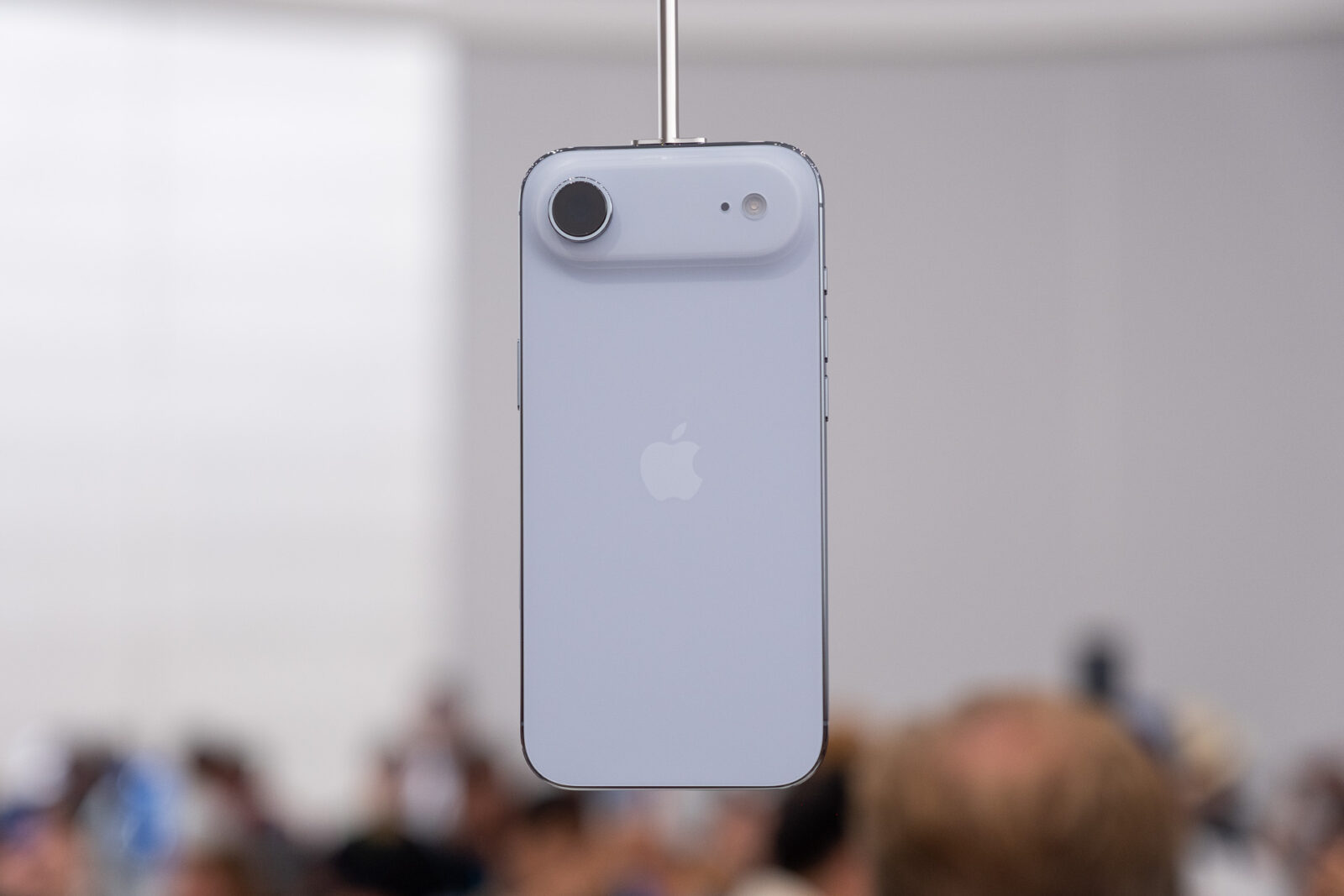
Apple rolled out a flurry of announcements this week, but none grabbed more attention—or embodied more paradox—than the iPhone Air. It’s Apple’s first iPhone to wear the “Air” badge, a branding usually reserved for devices that push the limits of thinness and portability. This time, Apple isn’t just introducing a new name—it’s carving out a new subcategory of iPhones, one that could set the tone for both present and future devices.
At just 5.64mm, the iPhone Air is impossibly slim. Gizmodo’s Senior Consumer Tech Editor, Raymond Wong, described it as feeling even thinner than it looks—and thinner than Samsung’s Galaxy S25 Edge, which is saying something. Think of it as the “Ozempic effect” for iPhones: lean, compact, and designed to make everything else suddenly feel bloated.
But as striking as its slender frame may be, the real story isn’t in what’s visible—it’s in what’s hidden beneath the glass. To understand that, you have to look at how Apple engineered this device.
Inside, nearly all of the iPhone Air’s computing guts—modem, antennas, logic board, and cameras—are concentrated in a single compact cluster tucked inside the camera bump. The rest of the chassis is dedicated almost entirely to an ultra-thin battery. In other words, Apple has shrunk an entire computer into a space so small it once seemed impossible. That kind of engineering is more than a design flex; it’s a blueprint for the future.

And the future, at least to my eyes, looks like AR glasses.
Why AR glasses? Because the greatest barrier to mainstream augmented reality isn’t concept or capability—it’s miniaturization. We already have the pieces: displays that fit into lenses, cameras small enough to blend into frames, UI systems designed for wearables. The problem has always been fitting them into something people would actually wear all day. To make AR glasses viable, everything needs to get smaller without losing power. The iPhone Air proves Apple is getting very, very close.
Bloomberg’s Mark Gurman recently reported that Apple scrapped a “stopgap” glasses project aimed at competing with Meta’s Ray-Bans, suggesting the company is holding out for something bigger—something that actually moves the needle. Imagine a pair of lightweight glasses that look like regular eyewear but can still run apps, display notifications, handle calls, and guide you through city streets with navigation overlays. That’s the dream. And if Apple can now fit the guts of an iPhone into a camera bump, then glasses-sized computing doesn’t seem like science fiction anymore.
Of course, there’s still the pesky matter of power. The iPhone Air boasts impressive battery claims—27 hours of offline video playback or 22 hours of streaming—but Apple also launched it alongside a MagSafe Battery Pack, which feels like a subtle acknowledgment that endurance might still be a weak spot. Scale that challenge down to AR glasses, and the issue only intensifies. High-brightness displays, audio, sensors, and apps will chew through power. Miniaturization is only half the battle; energy efficiency is the other.
Even so, the fact that we’re already here—holding a razor-thin iPhone with Apple’s most advanced A19 Pro chip inside—is remarkable. A few years ago, this would have sounded impossible: too fragile, too power-hungry, too limited by physics. Yet Apple made it work. And if history is any guide, when Apple makes something once thought impossible feel inevitable, the company rarely stops there.
So call me optimistic, but the iPhone Air feels less like a one-off experiment and more like a proof of concept. If Apple can slim down a full-blown iPhone into something this sleek, AR glasses that are powerful, wearable, and genuinely useful don’t just seem possible—they seem inevitable. Maybe sooner than we think.