
The American economy today looks increasingly like a colossal wager on artificial intelligence — one that could either redefine modern capitalism or expose deep systemic risks. According to Morgan Stanley investor Ruchir Sharma, nearly 40% of the United States’ GDP growth in 2025 can now be traced directly to AI-related investments. Even more striking, AI companies account for 80% of stock market growth, underscoring how dependent the U.S. economy has become on a single technological trend.
But behind the record-breaking valuations and headline-grabbing deals, a growing number of analysts are beginning to ask an uncomfortable question: what if all this money is just moving in circles?
A Billion-Dollar Circle of AI Deals
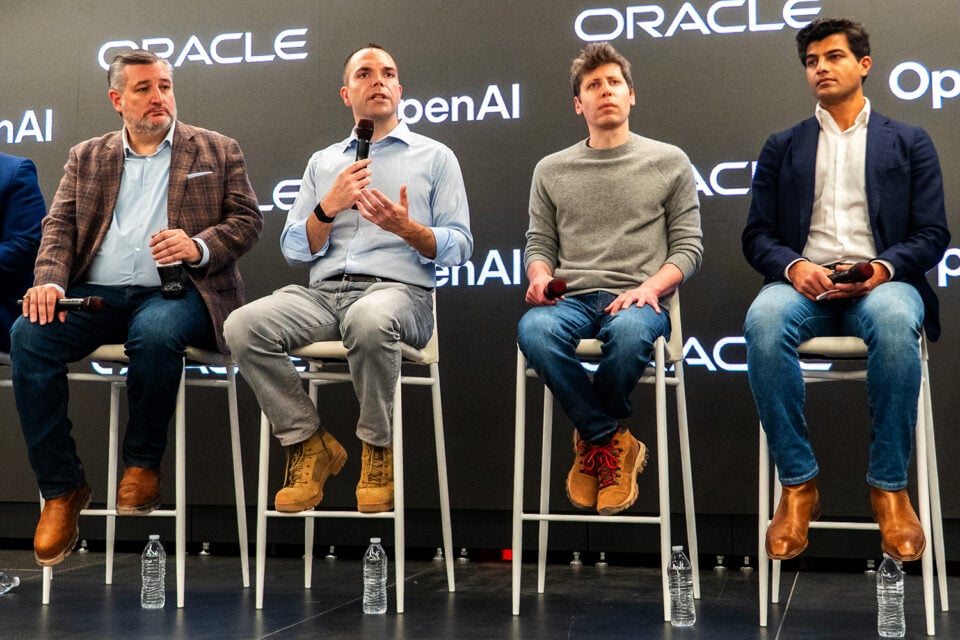
In recent months, three of the world’s largest tech giants — Nvidia, OpenAI, and Oracle — have struck a series of deals that, when viewed together, look suspiciously like a financial ouroboros:
- Nvidia pledged to invest $100 billion in OpenAI.
- OpenAI, in turn, agreed to spend $300 billion with Oracle for computing infrastructure.
- Oracle then announced plans to buy $40 billion worth of Nvidia chips.
On paper, these transactions make sense. Each company gains — Nvidia sells chips, Oracle rents servers, and OpenAI gets compute power to fuel its next breakthroughs. But step back, and the picture looks a bit strange: these corporations appear to be recycling the same pool of capital, each inflating the other’s valuation in the process.
So is this legitimate mutual investment — or a form of financial “round-tripping” designed to make everyone’s balance sheets look healthier than they really are?
Round-Tripping or Real Growth?
Financial experts are divided. Rishi Jaluria, an analyst at RBC Capital Markets, told Gizmodo that such deals could, in theory, be beneficial if they result in faster model development and tangible returns. “The better models we have,” Jaluria said, “the more we can realize use cases that are currently on hold because the technology isn’t powerful enough yet.”
But there’s a catch. “If that doesn’t happen — if there’s no real enterprise AI adoption — then it’s all round-tripping.”
Round-tripping refers to the unethical (and often illegal) practice of moving money in circles to artificially boost valuations. If these AI megadeals are more show than substance, then Wall Street’s AI boom could be running on nothing more than hype and hot air.
AI Adoption: Promise vs. Reality
The reality on the ground doesn’t entirely match the euphoria in the markets. OpenAI claims that 10% of the global population uses ChatGPT, and that 80% of businesses are exploring how to integrate AI into their operations. But according to an MIT survey, 95% of companies experimenting with generative AI have yet to see a single dollar of return on investment.
That hasn’t stopped stock prices from soaring. Oracle, for instance, recently reported a lackluster quarter — missing both revenue and earnings projections — but its shares still skyrocketed after revealing a 359% surge in future performance obligations, driven primarily by its AI-related contracts with OpenAI.
In other words, investors are rewarding promises rather than performance.
The OpenAI Nexus: Billions In, Trillions Promised
OpenAI sits at the center of this financial web. Its massive $300 billion cloud computing deal with Oracle, scheduled to kick off in 2027, would rank among the largest tech contracts in history. Yet, with OpenAI currently generating around $10 billion in annual revenue, it’s unclear how it plans to pay for it.
Similarly, its partnership with AMD — which includes potential ownership stakes and chip purchases worth tens of billions — raised eyebrows for the timing: AMD’s stock price surged 35% right after the announcement.
In total, OpenAI has committed over $1 trillion in compute-related deals in 2025 alone — an astounding figure for a still-private company valued at roughly $500 billion.
The Conveyor Belt of Capital
Economist Peter Atwater of William & Mary describes the situation as a network of “conveyor belts of capital,” with money endlessly circulating between the same players. “At the top of the mortgage market, money flowed from one party to another in an interconnected system that depended on every belt moving at once,” Atwater explained. “In many ways, we’re seeing the same developing web of capital flows across the AI space.”
This interdependence means that if any one company falters, the entire ecosystem could seize up. Like the 2008 housing crisis, where financial overcommitments cascaded through the economy, today’s AI giants may be building their empires on assumed future value rather than real productivity.
History Rhymes: Dot-Coms and Mortgage Markets
While some compare today’s AI boom to the Dot-Com bubble, Atwater believes the housing bubble analogy fits better. “In the frenzy of a bubble, everyone overcommits,” he said. “Once confidence begins to fall, those commitments are the first to be cut.”
Right now, that confidence is sky-high. The AI sector is fueled by the belief that its potential is limitless — that there will always be another breakthrough, another model, another billion-dollar partnership. But when confidence fades, investors will demand real-world profitability, not just vision statements and product demos.
The Illusion of Infinite Growth
Tech companies like Microsoft, Meta, Amazon, Tesla, and Google have collectively poured $560 billion into AI infrastructure over the past two years, yet have only generated around $35 billion in AI-related revenue. Those numbers don’t lie — and they don’t add up.
OpenAI’s own ambitions will require enormous energy infrastructure, including data centers that could consume as much power as New York City and San Diego combined. And even if those centers are built, there’s still no guarantee they’ll deliver meaningful returns.
As Atwater put it: “If you don’t have a real consumer for the product, there will be no AI space. These companies can’t continue doing this for nothing.”
The Question No One’s Asking
For now, the market sees only upside. Every announcement sends stock prices soaring. Every partnership looks like progress. But few are asking the most important question — the one Atwater says is always forgotten in a bull market:
“Why?”
Why are valuations soaring faster than actual innovation?
Why are companies trading billions between each other without clear deliverables?
And why is so much of America’s economic future resting on technology that’s still struggling to prove its long-term value?
Until investors start demanding those answers, the conveyor belt will keep spinning — faster and faster — powered not by profits, but by faith.