
Palmer Luckey—best known as the founder of Oculus and the inventor of the original Rift VR headset, before parlaying his Facebook windfall into Anduril, a defense company that builds surveillance systems and weapons for the U.S. military—now wants to sell you a $200 Nintendo 64–style console.
That pitch comes via ModRetro, Luckey’s retro-gaming venture, which recently teased a new update to its M64 console, first revealed back in July. The timing is notable: the announcement lands just weeks after rival company Analogue finally began shipping its widely praised Analogue 3D, a premium FPGA-based N64 console that many consider the current gold standard for replaying Nintendo 64 games on modern displays.
At first glance, a cheaper alternative to replaying classic N64 titles might sound appealing. But between the unclear technical details, aggressive marketing claims, and Luckey’s increasingly close ties to the military-industrial complex, there are both ethical and financial reasons some retro gamers may want to think twice.
A Black Friday Reveal
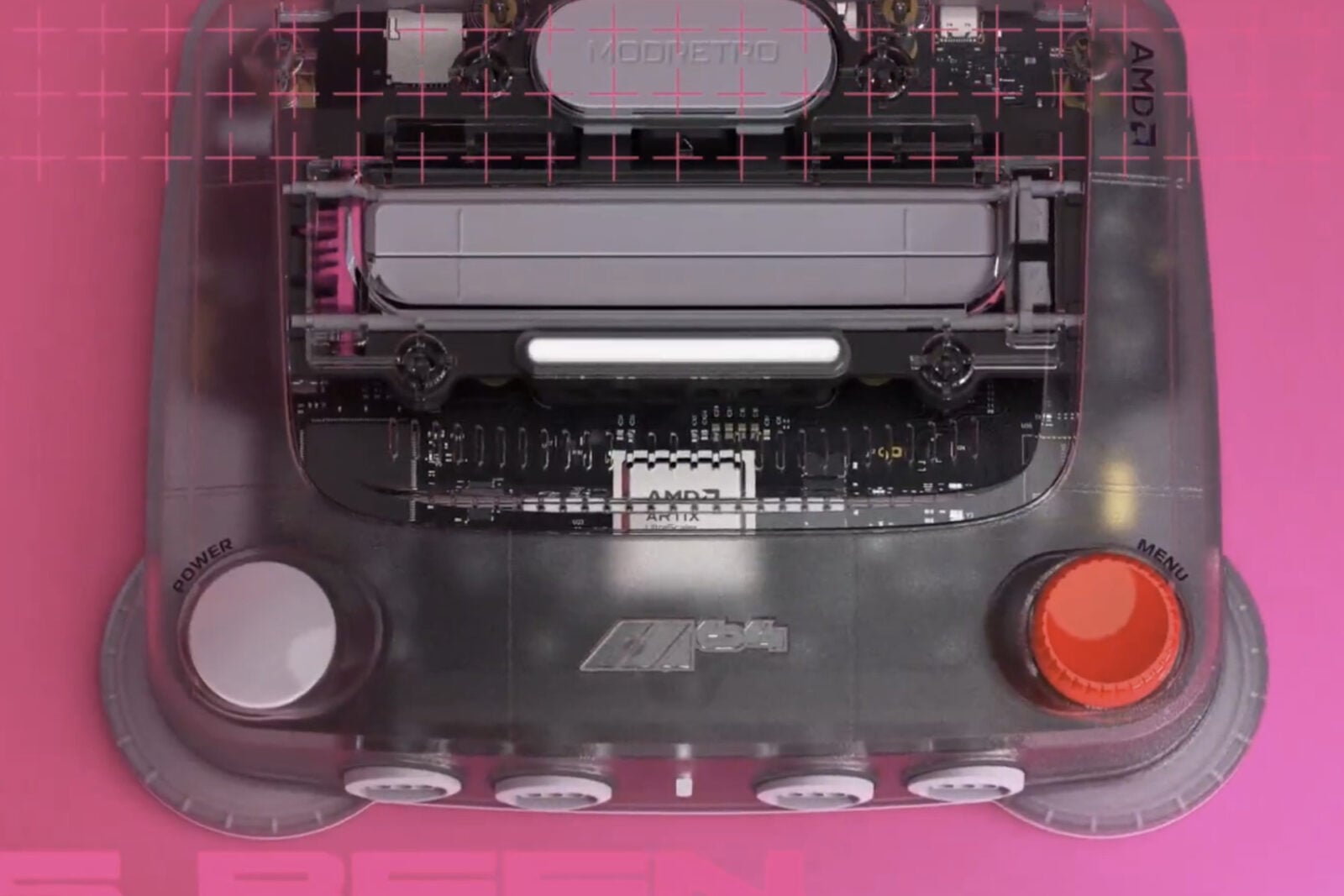
In a post on X, Luckey announced that ModRetro plans to fully unveil the M64 on November 28—Black Friday. Like the $270 Analogue 3D (which recently increased in price due to what Analogue says are tariff-related costs), the M64 uses an FPGA (field-programmable gate array) chip. Rather than traditional software emulation, FPGA systems replicate the logic of original hardware at the chip level—an approach favored by purists for accuracy and low latency.
In the M64’s case, that means recreating the internals of Nintendo’s original 1996 console, the company’s first system built around 3D graphics. The M64 reportedly uses an AMD-based chip, which is likely far more powerful than the one inside ModRetro’s earlier product, the handheld Chromatic, and potentially faster than what competitors offer.
Visually, the M64 appears to stick closely to the original console’s design language. It retains the classic four controller ports and cartridge slot for original N64 Game Paks. Some small visual flourishes—like colored accents on the power switch and a dial-shaped “Menu” control—hint at modern tweaks, but overall the look is conventionally retro.
Analogue’s console, meanwhile, also supports original N64 controllers and wireless 8BitDo replicas, and runs the company’s custom 3D OS, enabling features like CRT-style display modes and mild overclocking. ModRetro has yet to say what operating system or interface the M64 will use, leaving key details unanswered.
Pricing, Tariffs, and Undercutting the Competition
Luckey says the M64 will cost $200, and that the price will hold through Black Friday and beyond—despite ongoing volatility from tariffs tied to President Donald Trump’s trade policies. That puts the M64 $70 cheaper than the Analogue 3D, a deliberate undercut clearly aimed at nostalgia-driven gamers who remember when consoles didn’t approach $300.
But that discount comes with a caveat: buyers have to ignore the increasingly noticeable overlap between Luckey’s retro-gaming hobby and his defense contracting empire.
Open Source—or Marketing Spin?
FPGA enthusiasts noticed back in August that the M64 may rely on the MiSTer FPGA N64 core, a popular open-source project. While the Analogue 3D does not currently allow users to install their own FPGA cores, ModRetro has hinted at a more open approach. In an interview with The Memory Core, ModRetro marketing director Walter Lee suggested the M64 would embrace openness—at least to some extent.
Luckey, for his part, has repeatedly positioned the M64 as “the best way to play games at any price,” dismissing competitors as “inferior.” Whether those claims will hold up for nearly 30-year-old games remains to be seen.
Can You Separate the Console From the Arms Dealer?
Luckey founded ModRetro in 2024, reviving a name from his earlier days running Game Boy modding forums. But today, his primary focus is Anduril, a defense company deeply embedded in modern military technology—from autonomous drones to augmented reality systems for soldiers. Meta, his former employer, now partners with him on militarized AR hardware.
And despite claims that his gaming pursuits are separate, Luckey routinely blurs the line. On Joe Rogan’s podcast, he proudly described a version of his Chromatic handheld as being made with “the same alloy as our attack drone airframes” and coated in “the same low-signature ceramic used on Ghost X.”
Ghost X is a real combat drone, part of a growing class of autonomous weapons systems used in modern conflicts. According to the UN Human Rights Monitoring Mission in Ukraine, long-range drones and missiles killed 548 people and injured 3,592 others between January and October this year alone—numbers that represent a significant year-over-year increase. Defense industry reporting suggests the U.S. plans to significantly expand production of such drones.
Yes, many major tech companies have military contracts. But Luckey has made militarization not just a revenue stream, but a core part of his public identity and worldview.
The Choice
If what you want is the best N64 experience available today, the Analogue 3D remains the safer bet—even at a higher price—though it’s once again sold out following a restock on November 24. Anyone considering the ModRetro M64 will need to decide for themselves whether saving $70 is worth directly supporting a figure whose fortune now largely rests on building tools of modern warfare.
Retro gaming may be about revisiting the past—but buying into it still means reckoning with the present.