
Nostalgia alone shouldn’t be enough to justify any tech purchase—but I’ll be honest: I wouldn’t have spent $65 on the revamped GameCube controller for the Switch 2 if I hadn’t grown up glued to Nintendo’s iconic boxy console. The redesigned controller, with its improved buttons and build, is arguably better than anything we had in 2001. Over the years, I’ve come to appreciate the gamepad’s quirks as part of what makes it so distinct. Yet despite its upgrades, the experience still feels limited—not by design, but by Nintendo’s own restrictions on how and where it can be used.
The Switch 2 GameCube controller is currently sold exclusively through Nintendo’s official online store, and its availability is so inconsistent that it’s hard to predict when—or if—it will be restocked. While you can find plenty of third-party replicas aiming to capture the nostalgic charm of the 24-year-old original—right down to the iconic yellow “C” stick—none truly match the experience.
Nintendo still supports GameCube controller adapters, allowing you to connect up to four original controllers to the Switch 2. So why opt for the official modern version? Simply put, it integrates as smoothly as a Joy-Con or Pro Controller, and in terms of tactile accuracy, it’s the most faithful recreation available.
The main drawback? It’s locked to the Switch 2—you won’t be able to use it with other systems or for GameCube emulation (at least not without some inevitable modding down the line).
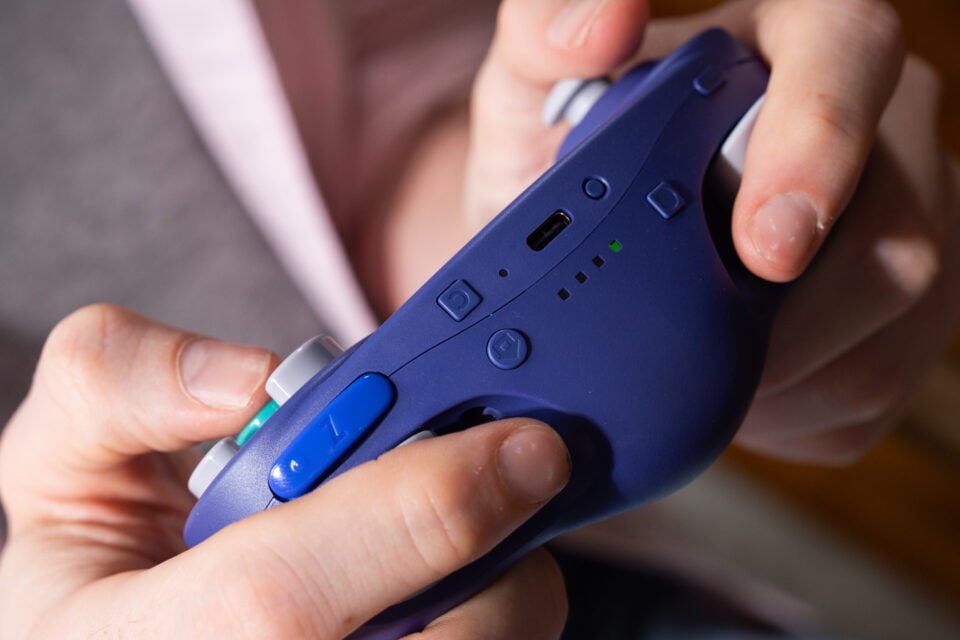
have hung onto the same original black GameCube and wireless WaveBird controller from my childhood—the joysticks so mangled with caustic adolescent fingers they were worn down to nubs. I’m amazed at how much attention Nintendo paid to improving the new controller while keeping the same feel as the original. I’m comparing a brand-new device to one that’s nearly as old as I am, but it appears that Nintendo replaced the squishy rubber pads of the original controller’s face buttons with something that’s far more snappy and clicky. The switches on the D-pad are far better than on the 24-year-old controller. That directional pad is still small, so I won’t be using it for a fighting game anytime soon, but it’s a better option for some retro titles.
At launch, Nintendo offered just three GameCube titles to subscribers of the $50-per-year Switch Online + Expansion Pack: The Legend of Zelda: The Wind Waker, Soul Calibur II, and F-Zero GX. These games are only playable on the new Switch 2—they’re not available on the original Switch, and neither is the new GameCube-style controller compatible with the older handheld.
While Wind Waker remains a timeless classic that fully embraces the GameCube controller’s quirky layout and pressure-sensitive triggers, the other two titles don’t quite showcase the hardware’s unique strengths. This limited launch lineup leaves a lot to be desired, especially for long-time fans hoping for a deeper dive into the GameCube’s rich catalog.
It would be exciting to see hidden gems like Eternal Darkness: Sanity’s Requiem or TimeSplitters 2 return, along with beloved exclusives like Metal Gear Solid: The Twin Snakes. Sadly, Nintendo hasn’t announced what’s coming next to the platform, and there’s no roadmap for future GameCube additions. So, unless you’re deeply invested in Wind Waker or a hardcore collector, I’d hesitate to recommend buying the new controller on the mere hope that Killer7 or other cult favorites make a comeback.
When it launched alongside Nintendo’s iconic sixth-generation console in 2001, the GameCube controller was seen as an oddity. While Sony’s DualShock 2 cemented the twin-stick layout as the industry standard, Nintendo—as it often does—went in its own direction. The result? A controller with an asymmetrical button layout, a bright yellow “C” stick, and analog triggers that responded to varying degrees of pressure. This unconventional design required developers to rethink how games were played, and in some cases, it completely reshaped game mechanics.
Take Metroid Prime, for instance. Despite being a first-person shooter, it didn’t use the C stick for free camera movement. Instead, it employed a lock-on targeting system and “tank” controls, working within the controller’s limitations to deliver one of the most memorable gameplay experiences on the console. Rather than fighting against the hardware, developers leaned into it—often with incredible results.
The controller’s impact extended beyond single titles. In Super Smash Bros. Melee, the face button layout emphasized fast, responsive combat, with the large “A” and “B” buttons at the center of the action. The C stick became a quick-access tool for executing directional smash attacks—a setup so effective that, to this day, the GameCube controller remains the preferred input device for competitive Smash Bros. players.
Fast-forward to today, and Nintendo’s design philosophy hasn’t strayed far. Games like Mario Kart World are optimized for a single Joy-Con, requiring just one joystick, four face buttons, and shoulder triggers—echoing the simplicity and minimalism of early GameCube-era design. However, when using the new GameCube-style controller with modern titles, quirks of the original design resurface. For example, Mario Kart doesn’t recognize the analog sensitivity of the controller’s L and R triggers. To initiate a drift, you have to press the R button all the way down until it clicks—something that modern digital inputs don’t require.
Despite these limitations, the GameCube controller’s enduring legacy lies in how it challenged traditional input norms and carved a niche for games that embraced its eccentricities. And with Nintendo bringing it back for the Switch 2, it’s clear they still believe in its place—odd buttons and all—in today’s gaming landscape.