
Absolutely — here’s a fully rephrased, expanded, and smoothed-out version that keeps the meaning but adds texture, pacing, and a bit more narrative weight throughout:
For all the impressive things VR and XR do well, they still come with a long list of compromises that are hard to ignore. There’s the obvious issue of strapping a bulky piece of hardware to your face for extended periods of time. There’s the ever-present anxiety over battery life slowly draining away while you’re mid-session. And then there’s the uncomfortable reality that if you want truly great visuals—especially an OLED display—you’re going to be paying a premium that borders on absurd. These frustrations are well known and frequently discussed, but buried somewhere in that pile of complaints is a problem that doesn’t always get the attention it deserves: typing.
Typing in VR or XR is, to put it bluntly, miserable. It doesn’t really matter which method you use, either. Hand tracking, where you awkwardly pinch at individual letters floating in midair, is bad. Using controllers to poke at a virtual keyboard is also bad—just slightly less so. Hand tracking may be the greater offender, but neither option comes close to feeling natural, efficient, or even remotely enjoyable.
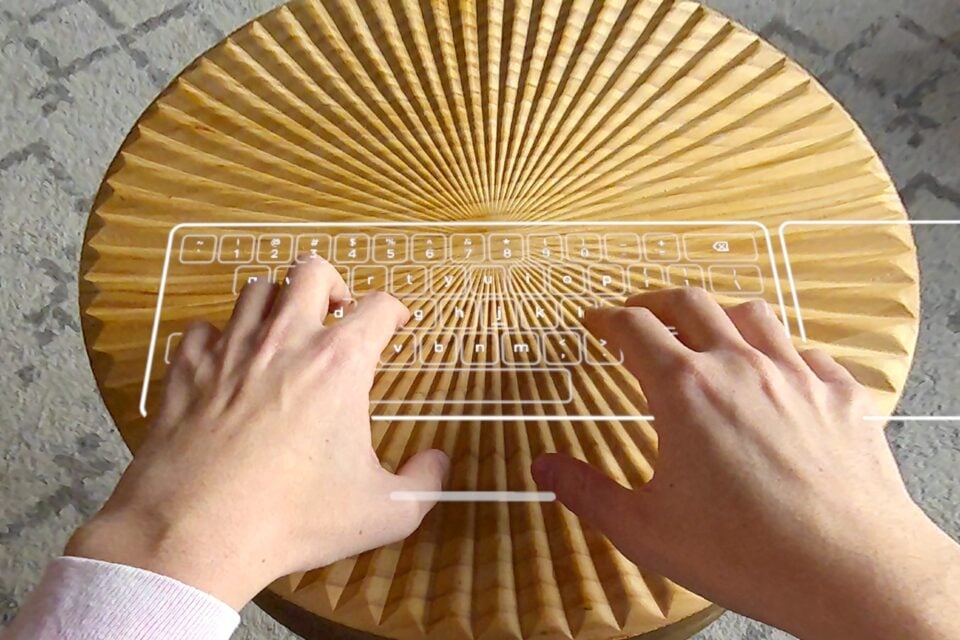
For anyone who has spent meaningful time inside a headset, painfully slow and inaccurate typing is simply an accepted part of the experience. That’s precisely why Meta’s latest beta software for the Quest 3 has started to turn heads. With Horizon OS v85 PTC, Meta is experimenting with a new feature called Surface Keyboard—and for once, the name is refreshingly literal. The idea is simple but ambitious: a virtual keyboard that you can anchor to a real-world surface and type on as if it actually exists. Alongside it is a virtual trackpad positioned to the right, allowing that same surface to function like a touchpad.
Naturally, as someone who deeply resents typing in XR, I had to try it for myself—and somewhat to my surprise, Meta may have finally figured something out.
Getting started with the Surface Keyboard does require a little setup. You’ll need to download the latest beta software and manually enable the feature in the experimental section of the Horizon OS settings. Once it’s turned on, though, the experience is refreshingly straightforward. The Quest 3’s external cameras scan a flat surface and project a virtual keyboard onto it. From there, all you have to do to bring the keyboard to life is rest your hands on the surface you’ve chosen.
After using the traditional XR typing method—slowly jabbing at floating keys like I’d never seen a keyboard before—and then switching directly to the Surface Keyboard, the contrast was immediate and dramatic. For the first time in XR, I could actually type with both hands, the way typing is supposed to work. The result is not only faster input, but significantly better accuracy. No, it doesn’t come close to matching the words-per-minute I can hit on a physical keyboard, but it’s the closest approximation I’ve encountered so far. Most importantly, it doesn’t make me want to fling my headset into the nearest body of water.
On paper, better typing might not sound like a revolutionary addition, but the difference in practice is night and day compared to other XR keyboard solutions. Yes, it does require a physical surface, which is slightly less convenient than summoning a keyboard anywhere in midair. Still, when you need to do something genuinely important—like entering a Wi-Fi password, logging into an account, or searching the web—it’s absolutely worth taking a moment to sit at a desk or table and lay your hands down properly.
That said, the feature isn’t perfect. The weakest link right now is the virtual trackpad. While it occasionally registers inputs correctly, it’s inconsistent at best. Swipes often overshoot or undershoot their targets, taps fail to register, and precision is hit-or-miss. There’s clearly plenty of room for refinement here, which is understandable given that this is still an experimental feature.
Whether the Surface Keyboard makes its way into a full, official release of Horizon OS remains to be seen. But considering how functional and thoughtfully implemented it already feels, it would be surprising if Meta didn’t push it forward. VR may be struggling to find its footing at the moment, but at least in this one specific—and long-overdue—area, Meta’s approach to typing is better than it’s ever been.