
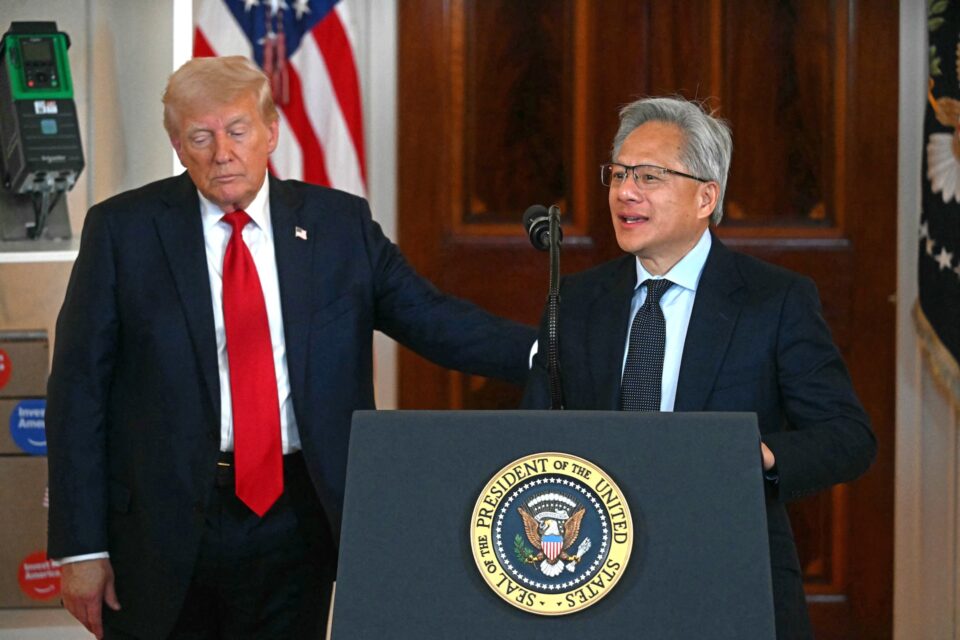
Former President Donald Trump announced in a new post on Truth Social that he intends to authorize Nvidia to sell its H200 artificial-intelligence chip to China, a move that immediately generated both excitement and scrutiny across the tech and policy worlds. Although the decision still maintains a strict ban on exporting Nvidia’s far more advanced Blackwell-series chips—currently considered among the most cutting-edge AI processors on the planet—it is nonetheless being widely interpreted as a significant win for the company. For months, Nvidia has struggled to find traction in China with its lower-performance H20 chip, which Chinese regulators and industry leaders reportedly dismissed as inadequate for many high-demand applications, leaving Nvidia with a major product stuck on the sidelines in one of the world’s most strategically important semiconductor markets.
Trump said on Monday that he personally informed Chinese President Xi Jinping of his plan to permit the sale of the H200 chips, emphasizing that the approval would occur “under conditions that allow for continued strong National Security.” He did not disclose what these national-security conditions would look like in practice—whether they involve technical downgrades, reporting requirements, usage oversight, or something else entirely. However, he added that Nvidia would be required to pay the U.S. government 25% of its revenue from H200 sales to China, a remarkably steep and unprecedented requirement for a private technology company engaged in the export of commercial hardware.
This announcement follows an odd and controversial agreement earlier in the summer in which Nvidia and AMD voluntarily committed to give the U.S. government 15% of their revenue from all AI chip sales to China, in what analysts described as an extraordinary and legally questionable arrangement. According to reporting from the Financial Times, experts said that no major U.S. corporation had ever entered into such a deal, calling it a bizarre quid-pro-quo structure that raised significant ethical, legal, and economic questions. Trump’s second term has been characterized by similarly unconventional, aggressive, and often norm-breaking policy decisions that have continued to confound specialists across national-security, constitutional, and economic fields. One of the clearest examples is Trump’s attempt to unilaterally reinterpret the 14th Amendment and challenge birthright citizenship, an action constitutional scholars overwhelmingly argue a president has no authority to do. Yet the U.S. Supreme Court, dominated by a conservative majority, has nevertheless taken up the issue—opening the door to an unprecedented reinterpretation of long-settled constitutional law.
Trump portrayed the forthcoming H200 approval as a major boost for American workers and for U.S. manufacturing competitiveness, although the decision still requires formal sign-off from the U.S. Commerce Department, which oversees export-control policy. Historically, Commerce has acted as a check on presidential impulses, but under Trump’s current administration, federal agencies have frequently mirrored his agenda with minimal resistance.
“This policy will support American Jobs, strengthen U.S. Manufacturing, and benefit American Taxpayers,” Trump declared. He went on to criticize the Biden administration, claiming that Biden-era export restrictions forced American chipmakers to design watered-down, “‘degraded’ products that nobody wanted,” arguing that such policies hampered technological innovation and reduced economic opportunity for American workers. In reality, the creation of reduced-performance chips is a strategic tool commonly used by the U.S. government to preserve national-security advantages by limiting high-end AI capabilities available to rival nations. Trump’s own administration has at times employed similar controls despite his criticism.
“That Era is OVER! We will protect National Security, create American Jobs, and keep America’s lead in AI,” Trump wrote, proclaiming a new chapter for U.S. tech policy under his leadership. He added that Nvidia’s American customers are already purchasing the company’s extremely advanced Blackwell chips—and soon, the next-generation Rubin chips—none of which are included in the arrangement with China, ensuring that U.S. firms retain access to Nvidia’s most powerful hardware.
Reporting from Bloomberg has shown that Chinese regulators previously encouraged domestic buyers to avoid Nvidia’s H20 chip due to performance limitations. While not an outright governmental prohibition, this guidance reduced market demand and effectively pressured the United States to reassess its export stance, especially given China’s role as the second-largest semiconductor market in the world. Losing access to China would not only hurt Nvidia financially but could reshape the global AI hardware supply chain.
Nvidia CEO Jensen Huang has developed a closer and more cooperative relationship with Trump during his second term, a trend mirrored by many other tech-industry leaders who are eager to influence federal AI policy. Those efforts appear to have been effective. David Sacks—widely referred to as Trump’s AI and cryptocurrency adviser—also publicly argued against heightened national-security concerns surrounding AI chip exports. According to reporting from the New York Times, both Huang and Sacks have maintained that limited sales of semi-advanced chips to China would not undermine U.S. security, asserting instead that such exports could increase China’s reliance on American technology rather than allowing Chinese firms to accelerate domestic chip development.
Meanwhile, Congress is preparing its own countermeasures. A bipartisan group of lawmakers from both parties recently introduced the SAFE CHIPS Act, a bill designed to block any attempt by Trump to overly loosen export restrictions. The legislation—authored by Republican Senator Pete Ricketts and Democratic Senator Chris Coons—demonstrates the rare bipartisan agreement that exists around countering China’s tech ambitions. Yet Congress has found it difficult to constrain Trump in practice. For instance, the TikTok ban, which began as bipartisan legislation and initially received Trump’s support, has gone through multiple sudden reversals, extensions, and delays. Trump has repeatedly extended enforcement deadlines while negotiations continue, with the next major deadline set for December 16.
“My Administration will always put America FIRST,” Trump wrote in his Truth Social post. “The Department of Commerce is finalizing the details, and the same approach will apply to AMD, Intel, and other GREAT American Companies. MAKE AMERICA GREAT AGAIN!”
Trump is expected to travel to Beijing in April for a high-profile meeting with President Xi, where the two leaders are likely to discuss not only chip-export policy but also broader issues of trade, national security, global supply chains, and the evolving balance of technological power between the two nations.